We are developing the social individualist meta-context for the future. From the very serious to the extremely frivolous... lets see what is on the mind of the Samizdata people.
Samizdata, derived from Samizdat /n. - a system of clandestine publication of banned literature in the USSR [Russ.,= self-publishing house]
Let me make my position unequivocally clear: I will not comply. If this scheme becomes law, I will resist it with every fibre of my being, joining the ranks of those who have historically stood against arbitrary power. This is a fight we cannot afford to lose, for it edges us closer to the continental nightmare of citizens as compliant serfs, beholden to an all-seeing state.
To understand the gravity of this threat, we must first confront the profound dangers it poses to our civil liberties. At its core, a mandatory digital ID transforms the relationship between citizen and state from one of mutual respect to one of constant suspicion and control. Imagine a world where accessing basic services, banking, healthcare, employment, or even public transport, requires scanning a digital credential that logs your every move.
This isn’t hyperbole; civil liberties organisations like Big Brother Watch have warned that such a system would create a “bonfire of our civil liberties,” enabling mass surveillance on an unprecedented scale.
The prime minister believes it would help crack down on illegal working and modernise the state, according to senior figures in government.
The practicalities of the scheme will be subject to a consultation, which will also look at how to make it work for those without a smartphone or passport.
The previous Labour government’s attempt to introduce ID cards was ultimately blocked by the Conservative-Liberal Democrat coalition.
But earlier this month, Sir Keir said he thought the debate had “moved on” since then, adding: “We all carry a lot more digital ID now than we did 20 years ago”.
“We all carry a lot more digital ID now than we did 20 years ago.” So we do, and that means we all have available a variety of independent digital means to prove our identity that are not subject to the danger of putting all our eggs in one government-made basket. Twenty years ago – well, 22 years ago to be precise – I made a post called “A law-abiding person has nothing to hide?” in which I listed some situations in which a law-abiding person could indeed be harmed by having their identity known by local or national government, or by whoever hacks into the government database, or by whoever gets their mate in the police to do a search for them. Has the passage of two decades made any of those scenarios, or the other scenarios suggested in the comments to the post, cease to apply?
I think the consequences of this will be very bad.
There will be even more Muslim terrorism worldwide. It evidently works.
There will be more use of tactics like taking hostages and livestreaming murders and torture for political effect by non-Muslim groups and states, too. These tactics evidently work.
Those people who think that Israel is committing genocide against Palestinians still won’t get to see what actual genocide looks like, but Israel will be more willing than before to kill Palestinian civilians in order to destroy Hamas. Israel has lost a major motive for restraint.
The less likely it is that Israel will defeat Hamas, the more it is in its interests to use other, cruder methods to deter and/or physically prevent future attacks from Gaza. These methods could include annexing some or all of the territory and expelling the inhabitants, or finally flooding the entire network of tunnels with seawater, only this time with no concern for ecological damage. The ecological damage would be the point. It is hard to secretly build military infrastructure in a barren desert, or to hide among civilians in a depopulated land.
Contrary to Sir Keir’s main motive for doing it, his government’s recognition of Palestine will cause even more British Muslims to change their vote away from Labour in favour of Islamic identitarian parties. As Osama bin Laden said, “When people see a strong horse and a weak horse, by nature they will like the strong horse.”
This formation of an explicitly Muslim power bloc will in turn cause even more non-Muslim British people to move from merely opposing further Muslim immigration to Britain (that sentiment is already practically universal) to wanting to get rid of the Muslims already here.
I do not wish for any of this. I just think it is what is likely to happen.
It’s worth at this point reminding ourselves what Starmerism is. Those getting wrapped up in the rigmarole of bond markets and gilt yields, Rachel Reeves crying, and fiscal headroom miss the point. Keir Starmer has no real interest in the economy as a domain of production and trade, consumption of goods and services. The closest he comes to an interest in markets is likely that “the economy should provide for everyone”. Instead, as the devout Starmerologist J. Sorel puts it: “everything about Keir Starmer’s life so far has taught him that his project — the defence of British society as it existed from 1997-2016 — can be achieved by simply illegalising all opposition. He openly avows this idea, and has never strayed from it.” Everything that Keir Starmer has remained devoted to has been the rejection of grubby, noisy, and messy politics, and the pursuit of constitutional reforms that would make it difficult for his foes to come back from.
Police have become embroiled in a free speech row after officers told a cancer patient to apologise for a social media post.
Deborah Anderson, an American citizen living in Slough, was confronted by an officer from Thames Valley Police after someone complained about an offensive Facebook post.
The police did not divulge which post had been the subject of the complaint.
The mother of two, who is undergoing chemotherapy treatment for cancer, was told that if she did not apologise for the comments she could be interviewed at the police station.
Ms Anderson, a vocal supporter of Donald Trump and a member of the Free Speech Union (FSU), refused and said the officer’s time would be better spent investigating serious crimes such as burglary.
Thames Valley Police later dropped the case after the FSU instructed lawyers.
However, the incident has reignited the debate over how far the police should intervene in social media spats.
The issue came into focus earlier this month when Graham Linehan, the Irish comedy writer, was arrested by five armed officers at Heathrow Airport over comments he had posted on X about a transgender activist.
Sir Mark Rowley, the Commissioner of the Metropolitan Police, has since said the police were in an impossible position when it came to such matters and called on the Government to provide greater clarity within legislation.
[…]
Ms Anderson was visited at home by a single officer in June and informed that Thames Valley Police had received a complaint about her.
In a video shared by the FSU, the officer said: “Something we believe you have written on Facebook has upset someone.”
Ms Anderson then asked: “You’re here because someone got upset? Is it against the law? Am I being arrested?”
The officer confirmed that she was not being arrested and explained: “My plan was that if it was you who wrote the comment, you could just make an apology to the person.”
Ms Anderson replied: “I am not apologising to anybody, I can tell you that.”
The officer told her: “The alternative would be that I would have to call you in for interview.”
Ms Anderson then asked the officer: “Are there no houses that have been burgled recently, no rapes, no murders? … Then why aren’t you out there investigating those?”
Lord Young of Acton, general secretary of the FSU, said: “Watching this video, it’s as if the police have become schoolteachers, intervening in petty squabbles. Since when has it been their job to ask people to apologise?
“Except instead of threatening you with detention if you don’t, they’re threatening you with arrest. It’s both comical and deeply sinister – carry on 1984.
A spokesman for Thames Valley Police said: “In June, we received a report from a person who felt threatened by comments directed at them online.
“Following engagement with both parties, no arrests were made and no further action was taken.”
If Plod the Prefect comes round to “engage” with you, do what Ms Anderson did and stand your ground. The chances are good that they will back off. Even if they don’t, you will have kept your self-respect.* This is the alternative.
*Another way to preserve your self-respect in these times is not to join the police. No officer should have to endure this type of deliberately humiliating hazing ritual.
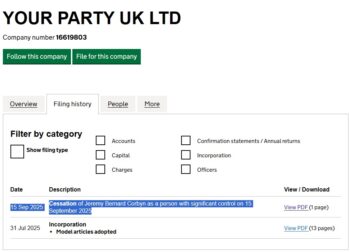
Jeremy Corbyn has just released an “urgent message” claiming today’s membership launch for ‘Your Party’ routed to an unauthorised domain and “legal advice” is now being taken. Which is odd, because Comrade Sultana told everyone to sign up using that very domain this morning…
“URGENT MESSAGE TO ALL YOURPARTY.UK SUPPORTERS
This morning, an unauthorised email was sent to all yourparty.uk supporters with details of a supposed membership portal hosted in a new domain name. Legal advice is being taken. That email should be ignored by all supporters. If any direct debits have been set up, they should be immediately cancelled.”
It appears that Sultana and Corbyn have now split.
“Whatever happened to the Popular Front?”
“She’s over there.”
The Bank lacks tools and legitimacy to tackle inflation. Labour should transfer that role to a new Inflation Control Office, which could use taxes, price controls and even rationing to lower inflation. Then Reeves should change the Bank’s mandate, radically: to support the economic policy of the government, not the City.
As a means to “save” Keir Starmer’s government, I am not convinced by the rationing bit. True, price controls are nearly always popular – until tried. But the people’s cry of “We want an Inflation Control Office to stop us buying things!” is heard only in Ann Pettifor’s dreams. I would advise less rich food late at night.
With this in mind, we may understand Reform better through considering the political thought of the party’s court historian, Sir David Starkey, than we do by mocking Dame Andrea Jenkyns’ sequinned conference sing-along. As summarised by Nicholas Harris in the New Statesman: David Starkey at conference “lectured on the Blairite coup of 1997, which he compared to a ‘slow burn French Revolution’… condemning ‘the catastrophe of human rights’, the Supreme Court and the ECHR… while musing on historical analogies for the coming Reform takeover: the 1832 Reform Act, the Glorious Revolution, the Stuart Restoration”. This is not conservatism as we have come to understand it, but counter-revolution: a swift and total toppling, through packing the Lords with sympathetic new peers, and a bonfire of Blairite legislation, of New Labour’s unloved and malignant constitutional order, the “theoretick dogmas” of our own revolutionary lawyers.
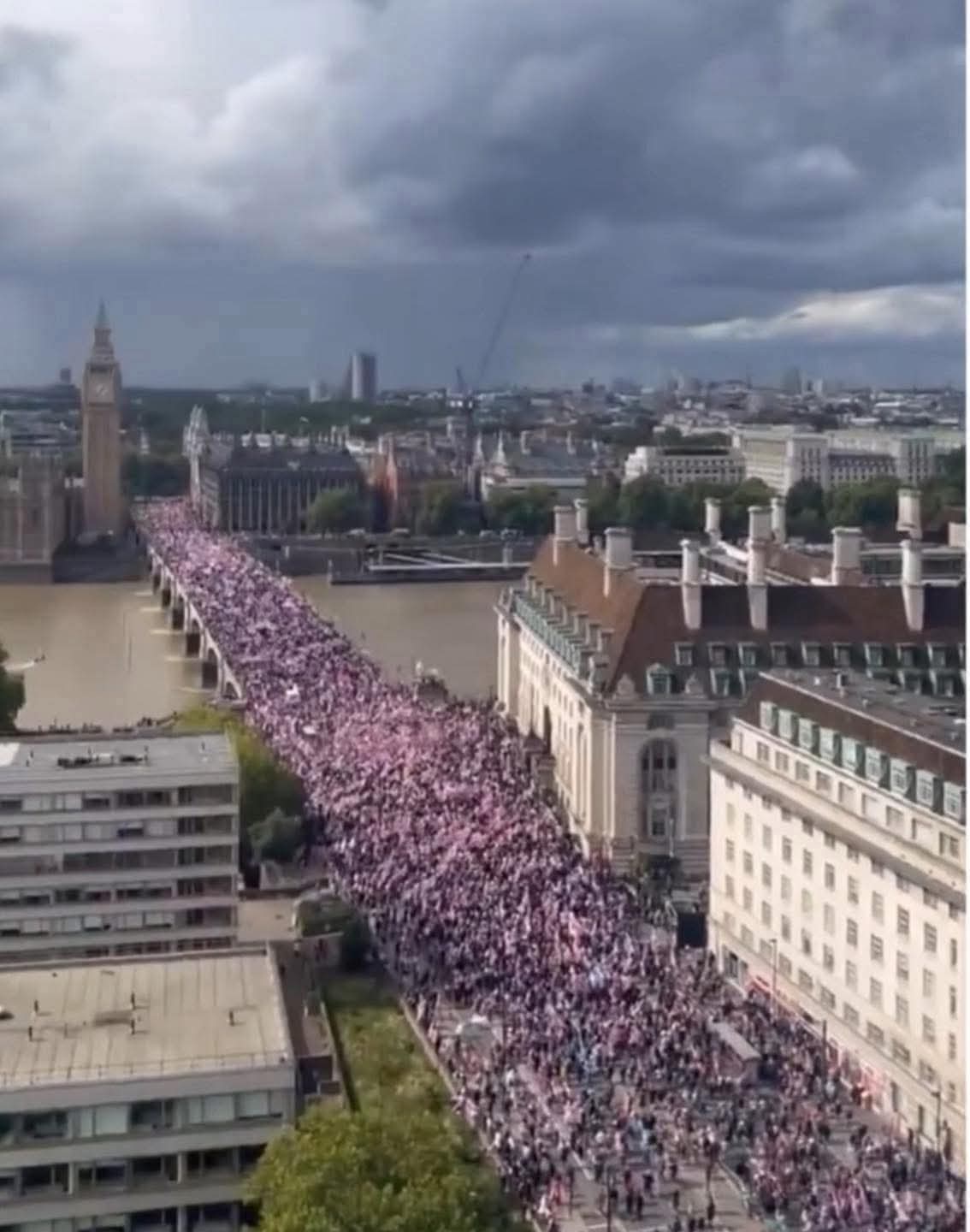
This has been the subject of some debate. Tommy Robinson says 3 million. The police say 150,000. That’s quite the discrepancy.
Oddly enough, I am in a rather good position to judge. I was there. Did I count them all? No, I didn’t. What I did do, however, was skulk around the back. Oh, and do some maths.
The plan was for everybody to assemble in Stamford St which, for those who don’t know, is a street in South London between Blackfriars and Waterloo Stations. Stamford St was packed and there was an overflow into Southwark Road, Blackfriars Road and Blackfriars Bridge. I was right at the back of the overflow into Southward Road. I would say that extended for – if I am being generous – 100m. (My apologies for using Nazi units but I can’t be arsed to do the conversion.)
Whitehall is 700m long. Stamford St is about the same length. So with the overflows we get 1000m of march. Stamford St is maybe 30m wide. So we get the whole march – I didn’t see many late comers – in 30,000m².
So how many people per metre? I understand the rule of thumb is 4. For comparison, Wembley manages to 90,000 people sat down in 90,000m². Four standing in the same space as one seated? Bit of a squeeze but possible.
Just to make this plain. Electricity is sold at the one price. We do not get charged different amounts for a green electron than a dirty brown one (we might well do dependent upon time of day, reliability of supply, etc, but that doesn’t change this particular argument). We have one price for the output. Whoever produces cheaper will make more profit. Because that’s just how profit works – revenue minus costs is profit. Therefore either renewables are cheaper and thus they make more profit or renewables are not cheaper and they make less profit.
There is no version of this story in which renewables are cheaper and yet they make less profit.
The Samizdata people are a bunch of sinister and heavily armed globalist illuminati who seek to infect the entire world with the values of personal liberty and several property. Amongst our many crimes is a sense of humour and the intermittent use of British spelling.
We are also a varied group made up of social individualists, classical liberals, whigs, libertarians, extropians, futurists, ‘Porcupines’, Karl Popper fetishists, recovering neo-conservatives, crazed Ayn Rand worshipers, over-caffeinated Virginia Postrel devotees, witty Frédéric Bastiat wannabes, cypherpunks, minarchists, kritarchists and wild-eyed anarcho-capitalists from Britain, North America, Australia and Europe.
All content on this website (including text, photographs, audio files, and any other original works), unless otherwise noted, is licensed under a Creative Commons License. Powered by WordPress & Atahualpa





Recent Comments