We are developing the social individualist meta-context for the future. From the very serious to the extremely frivolous... lets see what is on the mind of the Samizdata people.
Samizdata, derived from Samizdat /n. - a system of clandestine publication of banned literature in the USSR [Russ.,= self-publishing house]
|
Here is a fascinating YT documentary on Liechtenstein, that remote Elysium high on the young Rhine, with a long interview with the Prince himself, starting just before 6 minutes in, and running mostly to the end, in all 38 minutes. Some fascinating commentary from him on his policies and his country’s history, including the slightly farcical Nazi ‘March on Vaduz’ of 1938. Having started as a ‘rotten borough’ in the Holy Roman Empire, the first Prince to live there moved in as late as 1938. He is a fan of being in the EEA, unlike the Swiss, but he got it through via direct democracy. Every village has the right to leave the nation. He found inspiration for local democracy from Switzerland and the United States (at the State level one can infer).
They have a system where 11 municipalities (villages) engage in tax and regulatory competition with each other. He says that he is trying to make government work. (He’s not done badly). He wants them to deliver services with low cost and therefore low taxation.
Are you listening Mrs May, or are you changing your slogan to ‘Brexit means Anschluß’?
There is direct democracy, where you have to explain your policies. That actually means that people discuss government proposals and it provides stability despite the low threshold for proposing changes. He also has his royal veto power, last used in 1961 for a hunting law. The only law he can’t veto would be the abolition of the monarchy. Some less ‘royalist’ politicians note with almost heart-breaking sadness in their faces that by popular vote, the royal veto was retained, so they cannot prevail.
“…One kept taxation as low as possible so as to attract business…”
He asks why should taxes support banks. He notes that people are getting detached from governments, and states can get over-centralised.
GDP per capita: $139,000 (USA $59,000).
Of course, the people and what they do are what make Liechtenstein what it is. By God, it looks like a decent place.
Nongqawuse was a fifteen year old Xhosa girl who in 1856 had a vision in which three ancestral spirits told her that if the Xhosa people showed their trust by destroying their crops and killing their cattle, then on the appointed day the spirits would raise the dead, bountifully replace all that was destroyed, and sweep the British into the sea. Thousands believed this prophecy and slaughtered their cattle. But the dead slept on and the British remained in place.
Nongqawuse explained that this lack of action was due to the amagogotya, the stingy ones, who had kept their cattle back from slaughter. She urged everyone to greater efforts. A new date was set for the prophecy to finally come true. The rate of cattle-killing rose to a climax.
Eventually the Xhosa lost patience, and, with remarkable mercy, handed Nongqawuse over to the British. By then famine had reduced the population of British Kaffraria from 105,000 to fewer than 27,000.
*
City A.M. reports that John McDonnell says Venezuela is failing because it is ‘not a socialist country’.
Oh, and our Chancellor-in-waiting says that he will overthrow capitalism.
If you want to watch the Sunday Politics interview where he said all this, this BBC link will work for another 28 days.
…if I could find the right bloody sketch on YouTube. First I thought it was “Negotiations” from Not The Nine O’Clock News, but it wasn’t. My goodness, they wouldn’t allow the line at 1:30 nowadays, would they? Sticking with Mel and Griff, I then tried “The Union Man” with no better success. The sketch about Gerald the Gorilla was always a long shot.
Nope. Just couldn’t find it. It’s the one where there’s this meeting between the leaders of the different unions, the TUC or whatever they called it, and they are having a break and someone says, “tea or coffee?” and one of the blokes says, “let’s vote on it” and so they vote and tea gets more support, only the bloke who wants coffee has a block vote of three million when the all the ones who wanted tea together only added up to two million or something like that or vice versa. That one.
Look, back in nineteen whaty-whatever it was quite surprising to see anyone on TV mocking the trade unions. All the luvvies were lefties even then.
Anyway, I thought of that sketch when I saw this story pop up in the Guardian:
One million students join calls for vote on Brexit deal
Student organisations representing almost a million young people studying at UK universities and colleges are today joining forces to demand a referendum on any final Brexit deal, amid growing fears that leaving the EU will have a disastrous effect on their future prospects.
Predicting a young people’s revolt over the coming months, student unions – representing 980,000 students at 60 of the country’s leading universities and colleges – are writing to MPs in their areas this weekend, calling on them to back a “people’s vote” before a final Brexit deal can be implemented.
Student leaders said last night that they were planning action that would dwarf protests held in 2010 against the coalition government’s plans for student fees, and that they would not rest until they had been granted a say on their futures.
That’ll be one million for coffee then.
*
Breaking news: I am adding this clip of a random guy supporter of Zheremy Corbyn interrupting the current UK entry to the Eurovision Song Contest to shout, “Nazis of the UK media, we demand freedom!” because it is very important.
*
Edit: Hat tip to Patrick Crozier who found the relevant Not the Nine O’Clock News episode here. The block vote sketch in question starts at 8:00. The actual result of the vote was five hands raised giving one and a half million votes for tea, outvoted by Mel Smith’s five million votes for coffee.
Labour is now described as having an antisemitism problem. But those who talk like this are neglecting the fact that for many Corbynites antisemitism accomplishes something very important. It helps to drive out of the Labour Party all of those Labour supporters who think that the badness of antisemitism ought to be publicly talked about, instead of these Labourites silently or vocally caving in, for now, to the Corbynite project. And that, as far as the Corbynites are concerned, is a feature rather than a bug.
We can see this process described in this piece, by “New Labour” (i.e. the kind of Labour that the Corbynites are determined utterly to destroy) Prime Minister Tony Blair’s senior shouter-down-the-phone, Alastair Campbell:
In a speech to centre-left campaign group Progress, Mr Campbell said: “All my life I have been tribally Labour. But my Labour tribalism is being pushed to the limit – by the return of Militant style nastiness in local politics; by my revulsion that any anti-Semitism has been allowed to fester; by the feeling that some in the leadership, and their supporters, feel much greater animus against other Labour supporters than against Tories.”
Campbell is right. The Corbynites do indeed hate Campbell and his ilk far more than they hate the Conservatives. The Conservatives, by allowing themselves to be lead by people like Theresa May, are bringing the day of glorious socialist triumph ever closer. Campbell and his sort are a far more immediate threat to Corbynism. So if antisemitism serves to cure Alastair Campbell of his tribal love of Labour, … good for antisemitism.
As of now, the Corbynites are far more interested in establishing themselves in unchallengeable command of the Labour Party than they are in merely winning elections. Their thinking is that, sooner or later, capitalism will be hit by another crisis, and that at that point they’ll win a general election, and then the question will be: will there be any New Labour Alastair Campbell type bastards around to prevent them from turning Britain into Venezuela or worse? Meanwhile, they can agitate, do local activism, recruit the right sort of unswervingly loyal cadres, on the internet and in real life, and generally speed up the arrival of that crisis of capitalism and be ready for it. Having helped to bring about their crisis of capitalism, they can then blame capitalism for it and sweep to power.
At some point during all this, Corbyn will step aside and be replaced by a younger, better dressed and better shaved personage, more emollient, more “centrist” in tone, in appearance more like Alastair Campbell. Britain as a whole will be fooled. That “crisis” general election will be duly won, and then the “project” can really begin. And an essential part of that process is clearing out backsliding scum like Alastair Campbell, who, if they hang about and continue to attend Labour events, might blow the gaff in time to stop all this. At the very least such persons will be an unwanted nuisance.
Personally, I think that this is all a very long shot. But I wish it was a whole lot longer than it is.
The other thing to be said about antisemitism is that eradicating it from the Corbynite clan will be impossible. The Corbynites may, any year now, once all the Blairites are flushed out or permanently silenced, tone it down in public, once that besuited and beshaven person steps forward. But they will still all be antisemites.
→ Continue reading: Why Corbynites think that antisemitism is a feature rather than a bug and why Corbynite antisemitism won’t go away until Corbynism itself is destroyed
The story that I and most people here are familiar with is that in the 1840s Britain abolished the Corn Laws, became the pioneer in free trade and that this was a good thing.
John Nye begs to differ. In this Econtalk podcast (from, ahem, 10 years ago) he makes two points. Firstly, British tariffs were falling throughout the 19th Century and that the abolition of the Corn Laws was not particularly significant in that process. Secondly, French tariffs were by-and-large lower than those in Britain.
But surely Britain was much richer than France at this time? Yes it was, and according to Nye that was mainly due to it having fewer taxes and regulations. France even had internal tariffs as Samizdata’s own Antoine Clarke once pointed out.
So much as I don’t think Trump’s trade war is a good idea it is possible that it may not be as bad as all that.
The most recent of my Last Friday of the Month meetings was actually not on the last Friday of March because that was Good Friday, and my speaker Bruno Nardi and I decided to hold it a week earlier, on the 23rd. Bruno Nardi is a Brazilian libertarian and he spoke, unsurprisingly, about Brazilian libertarianism. The Brazilian state having become more than usually obtrusive and kleptocratic in recent years, libertarianism in Brazil is doing rather well just now. (I very much fear that libertarianism in Britain may soon be about to do rather well also, but that is another story.)
Before telling us about the contemporary libertarian scene in Brazil, Bruno prefaced that story with some Brazilian history, which I am rather ashamed to admit was almost entirely new to me. On the other hand, his basic point was that Brazilian history is rather undramatic, so maybe I needn’t be so ashamed after all.
Brazil started out as a Portuguese colony, but did you know that, in or around 1814, it became an independent Kingdom? Perhaps you did, but I didn’t. I did know that around that time, various armies were crashing about in Spain and Portugal, because the Duke of Wellington and his army were busy pushing Napoleon’s army back over the Pyrenees. But as to what happened in Brazil as a result of its Mother Country being invaded, well, I had never given it a thought. If Hitler had managed to invade Britain in 1940, you can well imagine Churchill and our Royals and a boat full of government functionaries hopping across to Canada, and setting up a new and “independent” kingdom of Canada. In Brazil, this is what actually happened. (Googling has made me more confused about the exact date of all this, but it definitely happened around then.)
In general, however, the history of Brazil is notable for its paucity of dramatic history dates. After 1814-ish, the next history date that Bruno focussed on was some time around 1880 or 1890, when there was this big Constitutional change, the nature of which I now forget, and which in any case, said Bruno, had little effect on regular life for most Brazilians. Then something else political happened in 1930. And then the next date to be discussed was 1964! I thought: hang about. Weren’t the times between 1930 and 1964 rather dramatic for the world? Well, yes, these were dramatic times, for the world. But for Brazil, not so much. Brazil pretty much sat out World War 2, just as it had pretty much sat out World War 1.
A little light googling has told me that Brazil has been involved in warfare, a bit, as Bruno did mention, especially during the nineteenth century against neighbouring states, notably Paraguay. There were a number of internal rebellions, all defeated. And Brazil did get involved in the world wars, fighting against Germany in both, a bit. So there definitely is such a thing as Brazilian military history. But Brazilian involvement in war was indeed nearly nothing compared to what the European nations were doing to one another and to the rest of the world during those same times, or compared to such events as the American Civil War.
War, we libertarians are fond of telling each other, is the health of the state. Peruse the most recent posting here by our own WW1 historian, Patrick Crozier, to see how we often think about such things. So, what about that increasingly obtrusive and kleptocratic Brazilian state that has been putting itself about lately, stirring up misery and libertarianism? There have been no big wars to make the Brazilian state as healthy as it now is, and especially not recently. What of that?
The story Bruno Nardi told made me think of the book that explains how peace is also the health of the state, namely Mancur Olson’s public choice theory classic, The Rise and Decline of Nations. It is years since I read this, but the story that this book tells is of the slow accumulation and coagulation of politics, at the expense of mere business, as the institutions of a hitherto thriving nation gang up together to form “distributional coalitions” (that phrase I do definitely recall). The point being that if you get involved in a war, and especially if you lose a war, the way Germany and Japan lost WW2, that tends to break up such coalitions.
The last thing on the mind of a German trade unionist or businessman, in 1946, was lobbying the government for regulatory advantages or for subsidies for his particular little slice of the German economy. Such people at that time were more concerned to obtain certificates saying that they weren’t Nazis, a task made trickier by the fact that most of them were Nazis. Olson’s way of thinking makes the post-war (West) German and then Japanese economic miracles, and the relative sluggishness of the British economy at that time, a lot more understandable. Winning a war, as Olson points out, is not nearly so disruptive of those distributional coalitions, in fact it strengthens them, as Crozier’s earlier posting illustrates.
You’ll get a bit more of the flavour of Olson’s thinking if you read this SQotD from 2012.
I met up with Bruno Nardi again last week at a Libertarian Home meeting, where I spoke to him along the lines sketched out in the previous paragraphs, mentioning the title of Olson’s book, and I ended up by asking: Does that ring any bells with you, as a way of talking about Brazil and its history? Yes, he said, that’s what it was like. Gradually the political crooks got their various acts together and made their various deals and accommodations, and it got worse and worse and the state that they negotiated between them got bigger and bigger.
In Brazil, the idea of libertarianism has usually been felt as foreign. But it’s an idea that Brazilians are now definitely getting told about.
You can read Bruno Nardi’s recent postings at Libertarian Home by going here. I particularly like the one entitled Take the hypothetical seriously. What if? What if, although Bruno didn’t ask this in that piece, Brazil was governed differently, in a more freedom-friendly way to the way it has been governed for the last few decades? And what if the same applied everywhere else?
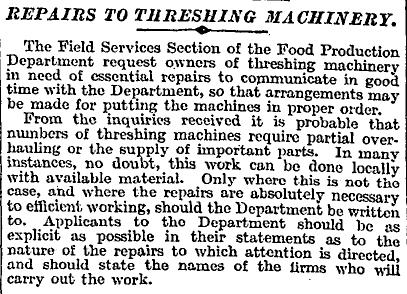
Much as I accept that the First World War was ghastly I believe it had to be fought. However, as I have followed events in “real time” as it were, I have had to reluctantly accept that to fight the war required a substantial increase in the size of the state. Conscription, rationing and a Ministry of Munitions, for instance, were essential. Even so, some extensions of state power are simply baffling:
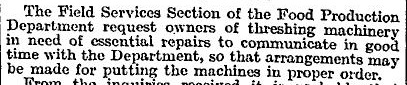 The Times 30 March 1918 p2
Huh?
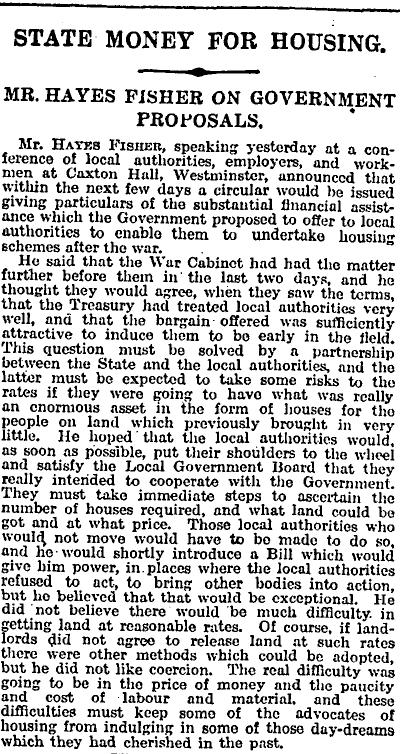
It gets worse. While most people were busying themselves fighting the war, statists were making plans…
 The Times 15 March 1918 p12
I love that phrase in the linked article about not liking coercion. I also note that no attempt is made to explain why state provision would be better than the private-sector alternative. It is simply assumed.
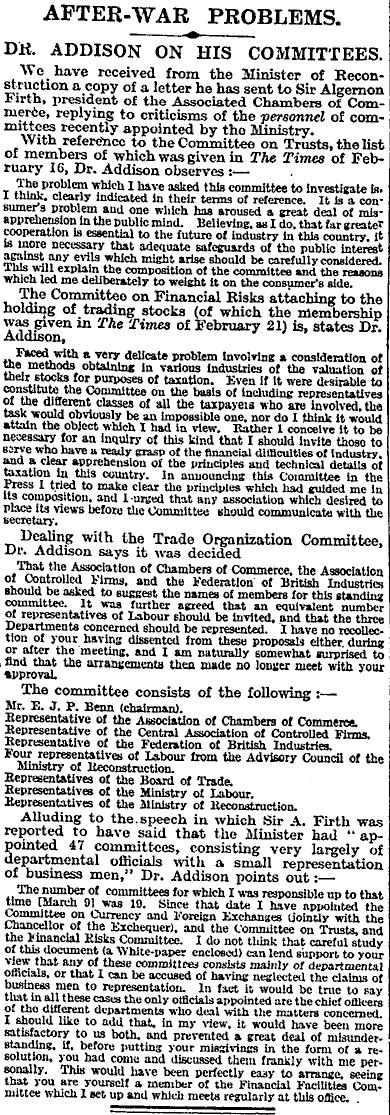
There was a lot of this sort of thing going on. While the cat is away the mice shall play, so to speak. One of the committees that sprang up around this time had a rather surprising member:
 The Times 4 April 1918 p3
Many will know that Ernest Benn was Tony Benn’s uncle. Many will also know that he was one of the founders of the Society of Individual Freedom. The Society of Individual Freedom spawned a youth wing which came to be known as the Libertarian Alliance and the Libertarian Alliance to a large extent was responsible for Samizdata. As it happens Benn was, at this time, in his statist phase. He would soon learn.
Today marks the centenary of the Royal Air Force, established for bureaucratic convenience at the start of a financial year in 1918, beaten in the age stakes by the Finnish Air Force, formed on the preceding 6th March, a Force which has higher scoring aces, with implausible names like Hans Wind, but I digress. Whilst I am not one to celebrate bureaucracies (and the RAF is a bureaucracy), it has the merit of having done much to banish tyranny from the world, and has many tales of heroism in its relatively short history, even if for one-fifth of that, it has been part of the Blairmacht.
Today I would like to note one incident in the RAF’s history, which came at the ‘half-way’ mark, when in 1968, (actually on 5th April) after Harold Wilson’s Labour government decided not to commemorate the RAF’s 50th anniversary with a fly-past, and this did not go down well at all. In fact, it went down so badly that one RAF pilot, the heroic Flight Lieutenant Alan Pollock, threw away his career and very nearly his freedom in the ‘Tower Bridge incident‘, when, in protest at the lack of a commemoration, in his Hawker Hunter jet, he ‘buzzed’ the Houses of Parliament. Then on the spur of the moment, going down the Thames towards the sea, he flew under the top span of Tower Bridge at around 400 mph, and also ‘beat up’ a few airfields inverted, before landing, getting arrested but avoiding a court martial after being demobilised on health grounds by superiors eager to avoid the publicity of a trial, which is a weird echo of a similar ruse used in Viktor Suvorov’s ‘The Liberators’ when a Soviet Army soldier’s conduct presented a bureaucratic embarrassment that could not be concealed from higher authority. The jet only just missed hitting the top span of Tower Bridge with its tail, so no harm was done, however, it was close, there was a double-decker bus on the bridge at the time, and a cyclist on the bridge ripped his trousers dismounting in haste. Flt-Lt Pollock gallantly offered to pay for the trousers, but the cyclist declined.
It is a tribute to the political culture of the UK that discontent manifested itself in this way, rather than in something like a tanquetazo . The World would also be a better place if more people, like Flt-Lt Pollock, placed acting out of good principles over doing what is needed to maintain one’s position or career, when one is led by disgusting ones.
UPDATE: The Daily Mail have done a full interview with Alan Pollock, here it is.
An unnamed West Yorkshire police officer has managed to attempt to pervert the course of justice by getting himself summonsed for driving an untaxed vehicle, when he accidentally put his own details on a form instead of those of the alleged miscreant, reports the Daily Mail.
Members of West Yorkshire Police’s Roads Policing Unit (RPU) took to Twitter to mock another member of their team who appears to have put his own name on a form rather than the real offender.
I’m pretty sure that a humourless American prosecutor would seize on this as obstruction of justice by wrongly reporting yourself as the ‘perp’, and to be fair, it does seem to have all the necessary elements of causing wasteful employment of police time in UK law.
Our wonderful mini plea-bargain system of fixed penalty notices in the UK allows you to buy off a prosecution, or go to Court and challenge the basis of the ticket and risk conviction.
Whilst the UK may seem more and more like East Germany as time goes by, witness recent police action on free speech, it is heartening that the police are managing to boost their summons rates in a way that cuts out the unfortunate middleman, like the Armenian Orthodox Priest in Soviet Russia who, having a conspiracy beaten out of him by Stalin’s NKVD, managed to name as his co-conspirators every member of his congregation that he had buried in the past 3 years, thus enabling his tormentors to fill their quota with ‘real’ people. At least for now, this is a laughing matter. Should Comrade Yezhov‘s admirers take power, it might not be so nice.
Hopefully from a future in a parallel universe…
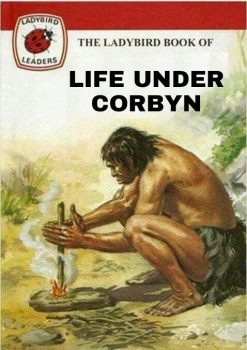
(found sloshing around on the interwebz)
A senior English police officer has called for children of extremists to be taken away from them.
Terrorists should have their children taken off them in the same way that paedophiles do, Britain’s outgoing top anti-terror policeman has said.
Assistant commissioner at the Metropolitan police, Mark Rawley, said that children of terrorists were exposed to environments equally as “wicked” as victims of paedophiles were and so should be afforded the same protection.
In his valedictory speech, he told the Policy Exchange: “If you know parents are interested in sex with children, or if you know parents believe that people of their faith or their belief, should hate everybody else and grow up to kill people, for me those things are equally wicked environments to expose children to.”
Meanwhile, far away in Argentina, the Grim Reaper has finally called for one of the old ‘Dirty War’ Generals, Luciano Benjamín Menéndez (cousin of the clown who was ‘Gauleiter’ of the Falklands in 1982 until some Paras, Guards, Marines and Gurkhas et. al. turned up).
Menéndez, also known as “The Hyena,” was the military commander of ten Argentine provinces from 1975 to 1979.
Some 30,000 people are estimated to have been killed by the military in its infamous Dirty War against dissidents.
Menéndez was also convicted for abducting children from detained anti-government activists and giving them up for adoption.
The children were often adopted by families of military officials, who strived to give them a non-communist upbringing.
The Montoneros were a murderous bunch for sure. But why does a senior English police officer think it is appropriate to imitate a South American Junta?
The Sage of Kettering and I have been on another trip, not to some distant, warm, European setting, but a distinctly chilly Suffolk on a bright early Spring day. Here is my account of our trip to an oft-overlooked corner of England and a dip into the past, focusing on the damage done by the iconoclasts. I am indebted beyond measure to the wonderful Suffolk churches site for inspiration on what to see, and links to pictures.
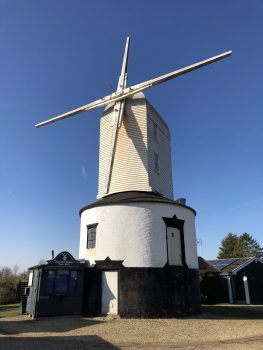
The first stop was a quick look at a proper windmill, unfortunately under repair, the Post Mill at Saxtead. So much more attractive than the hideous electric-powered windmills that clutter the landscape, sucking up subsidies and slowing down the wind.
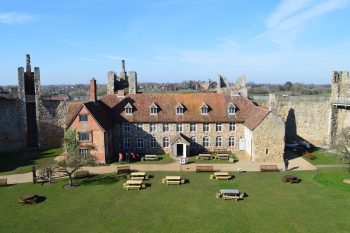
Next stop, the focus of our trip, Framlingham Castle, a series of towers with no inner keep, but it does contain an old Poorhouse. Noted as the place where Mary Tudor was when she was proclaimed Queen after the tumult of Edward VI’s death, and she then went on to make her mark with an unwise marriage and her trademark of barbecuing Bishops.

The walls of the castle are impressively high, with an excellent ditch.

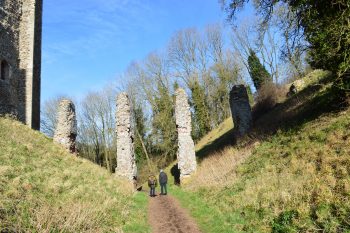
Around the towers, there are Tudor chimneys, allowing some local heating.
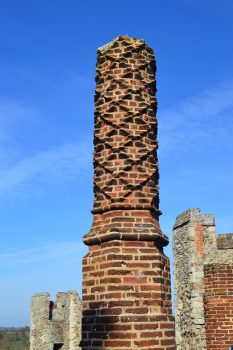
The castle does not have a keep inside it, it is just a wall with a series of towers. The space inside was used to build a poorhouse.
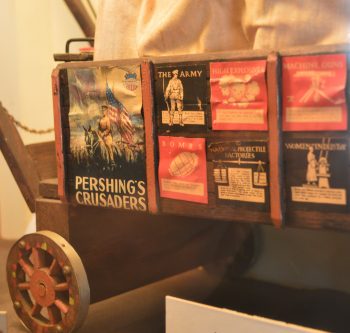
And in the Poorhouse is a local museum, with a fine collection of curious, including this tribute to General Pershing and his Crusaders.
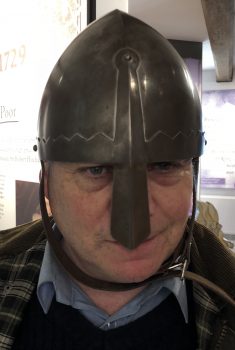
The Sage decided to try out the headgear, it might be useful with canvassing with local elections coming up.
→ Continue reading: A Suffolk sortie
|
Who Are We? The Samizdata people are a bunch of sinister and heavily armed globalist illuminati who seek to infect the entire world with the values of personal liberty and several property. Amongst our many crimes is a sense of humour and the intermittent use of British spelling.
We are also a varied group made up of social individualists, classical liberals, whigs, libertarians, extropians, futurists, ‘Porcupines’, Karl Popper fetishists, recovering neo-conservatives, crazed Ayn Rand worshipers, over-caffeinated Virginia Postrel devotees, witty Frédéric Bastiat wannabes, cypherpunks, minarchists, kritarchists and wild-eyed anarcho-capitalists from Britain, North America, Australia and Europe.
|





Recent Comments