We are developing the social individualist meta-context for the future. From the very serious to the extremely frivolous... lets see what is on the mind of the Samizdata people.
Samizdata, derived from Samizdat /n. - a system of clandestine publication of banned literature in the USSR [Russ.,= self-publishing house]
|
This call [original link removed] for a rally in Trafalgar Square next Saturday is interesting. Does anyone know any more details of who is behind it? I would like to know more before leaping to any conclusions.
update: question answered – not worth supporting one group of (white) fascists protesting against another group of (Islamic) fascists
Recently, a Greenpeace boat was rammed by a Japanese whaling ship. Or vice versa, depending on which side of the fence you sit on. Somewhere in my blogospheric wanderings, I stumbled over a Greenpeace blog purportedly authored by the crew on that particular mission. Since sparring with members of the crew and those peopling their fawning commentariat, I am reminded yet again how soft-headed, shallow and emotionally driven the anti-whaling argument is.
It continues to amaze me how, over the years, Greenpeace has pulled off such a remarkable public relations campaign in regards to whaling. They have successfully ensured the utter ignorance of many hundreds of millions of otherwise intelligent individuals on the matter of whaling. For most opposed to whaling, there is one species, “the whale”, and it is being fished into extinction by those nasty Japanese. Forget the fact that some species of whale are not even close to endangered. The minke, for example, has an international population ranging somewhere between 500 000 – 1.1 million individuals. The minke is the most commonly harvested whale. Icelandic and Norwegian whalers only hunt minkes and the vast majority of the Japanese catch consists of minkes. Forget the fact that, when the Japanese hunt other species, each year they have never taken more than 51 Bryde’s whales, 10 sperm whales or 100 sei whales. If you want to check the population levels on each of those whale species, please take a look at the earlier IWC chart I linked to. To suggest this tiny rate of harvesting will have a negative impact on whale populations is preposterous. Even if the Japanese follow through on their threat to double their cull of minkes to about 1000, and – let’s be generous – add another 1000 taken by the Icelandic, the Norwegians and indigenous groups, this cumulative figure of 2000 is clearly sustainable given a conservative population growth rate of 1% and a highly conservative total population of 500 000.
Another point that the anti-whaling wailers do not like to concede and invert in their rhetoric; whaling in international waters is not illegal. Membership of the International Whaling Commission is entirely voluntary, and no member is bound to accept its rulings. For example, IWC member Norway has been catching minke whales under an objection to the moratorium on whaling since it was put in place in 1986. Japan, whilst almost certainly running a misleading campaign that asserts its catch is predominantly for scientific purposes, could withdraw from the moratorium on commercial whaling and start openly whaling commercially any time it wanted to.
A further blow to the relevance of the anti-whalers’ cause can be seen in the dwindling market for whale meat. Even arch enviro-moonbat David Suzuki concedes that the market for whale meat is falling in Japan. The same thing is happening in Norway, according to other environmental hysterics. Simply, the young don’t much care for the stuff in Japan or Norway. The market for whale meat is literally dying. As for any potential non-culinary demand in the West, we no longer need whale oil, and there are far cheaper sources of pet food. When viewed rationally, whaling is a non-event, and its importance is further deflating.
Considering the above, the anti-whaling campaign seems like a ridiculous waste of energy if “saving the environment” is key. One of the eco-pirates on the Greenpeace boat claimed, in a response to my initial post on their blog, that “Greenpeace’s position is based purely on the need to leave healthy intact ocean ecosystems for future generations.” If they were truly a group concerned with preserving ocean ecosystems, they would be concentrating their efforts in South East Asia, where numerous fisheries are in various stages of collapse due to rampant overfishing. The whaling debate shows Greenpeace for what they are – a bunch of filthy hypocrites who ignore true environmental catastrophes to chase after high profile red herrings. Please pardon the pelagic pun.
Incoming email:
Greeting!
Keith Burgess Jackson, a tenured philosophy professor, has just started a new blog designed to deflate thuggish far-Leftist blogger, Brian Leiter. Leiter has a lot of influence and uses it to harm people who dare to challenge him. So Keith wants to try to civilize him a bit. Apparently Leiter is obsessed with his reputation. Keith says that Leiter scours the Internet for references to himself and then writes to people to get bad references removed. He has also apparently hired a lawyer to get the University of Pennsylvania law students to take down their rankings blog. Keith wants to put him down, but only by saying true things about him. Truth is an absolute defense to defamation. If you would like to help, at least please blogroll the new blog so that it rises in Google’s rankings, so that when people type “Brian Leiter” into Google, the new blog comes up. I myself have no connection with the new blog – just a wish to see it thrive. The blog is here: http://brianleiter.blogspot.com
Thanks
John Ray
Sounds like a laugh. Presumably this posting will help.
I have no idea just how much of a shit this Brian Leiter is, and how much he contributes to the “Brians are bad” syndrome, but I expect that he is indeed a shit to some degree. I will visit this blog a few times, and then decide if I want to keep reading it. If I do, I will then blogroll it, here.
Nearly forgot. Happy New Year everybody.
From David Tebbutt:
This is the promise: “The Habitat JAM will gather your input and add it to thousands of others to identify actionable ideas for the Vancouver World Urban Forum agenda and influence the Forum’s content. It will start conversations and build new networks that bring enormous potential to global problem solving.”
It sounds more like a threat to me. At best, manipulated bullshit. Problem solving is a fine thing, but the fewer conversations and networks devoted to “global” problem solving, the better, I would say. This is, I think, because “global” bundles together lots of difficulties into one huge impossibility, which you then blame on global capitalism. But the way to actually solve problems is to do what actual capitalists actually do, which is break the problems up into solluble particles.
Still, “actionable” means that someone will at least be able to sue these people, yes? No. Non-responsibility for resulting chaos is of the essence of gatherings like this.
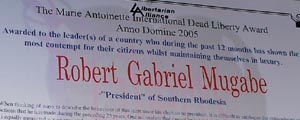
In response to overwhelming popular demand (Julian Taylor can be a bit overwhelming sometimes) here is the text of the Marie Antoinette International Dead Liberty Award for the year 2005, which has been awarded by the Libertarian Alliance to Robert Gabriel Mugabe, and which I featured yesterday in one of these photographs.
Click on this:
I hope you (Julian Taylor) can read that okay, and that it need not be typed in, again.
So, since we are on the subject of Mugabe, how are things in Zimbabwe these days? Well, this story says quite a lot:
Harare, Zimbabwe, 11/17 – A magistrates court in Zimbabwe Thursday dropped corruption charges against President Robert Mugabe`s nephew, two weeks after his high profile arrest on suspicion of graft involving billions of dollars.
Leo Mugabe and his wife Veronica were arrested on charges of illegally selling flour on the local market and exporting it to Mozambique.
Trade in wheat and flour, both of which are in short supply here, is controlled and exports are banned to preserve stocks for the local market.
No evidence, according to the magistrate. I do not suppose that lack of evidence is usually much of a problem, in Zimbabwe nowadays. But this case must have been rather different.
I wonder how Robert Mugabe himself feels about this. I do not assume that he will automatically side with his nephew. As I wrote here, a while ago, I was briefly acquainted with another relative of his, and I can report that the Mugabe family is not the proverbial big happy one. They do not all stick together. They quarrel. And Robert Mugabe is easily stubborn enough and self-righteously cruel enough to throw a relative to the wolves, if he decided that this was the right thing for him to do, just as he has decided that wrecking Zimbabwe is the right thing for him to do and will stubbornly continue with that, until death or ruin stops him.
In other words, this Libertarian Alliance prize will change nothing in Zimbabwe, nothing at all. But, future recipients of the award may perhaps be influenced by it.
The whole issue of Walter Duranty’s Pulitzer Prize in 1932 has always pissed me off. It just rankles that he got away with it, so the least we can do is blacken the bastard’s name posthumously for the sake of the millions of dead Ukrainians he lied about.
Now that Harold Pinter has won a Nobel Prize for literature, I guess the tradition of lionising men of letters who are apologists for mass murdering leftists is still alive and well.
Want to make your voice heard on the issue of Walter Duranty’s Pulitzer Prize? Take a look at Cyber Cossack (and check out their great site banner) and if you are in the NY area, consider lending your hand to a bit of activism.
Better late than never.
Tomorrow (Wednesday) the issue of trade justice will be topical. Free-market NGO Global Growth is looking for volunteers in London who would be willing to help with a stunt outside the French Embassy. If you are free in the middle of the day tomorrow, e-mail your details to info at global-growth.org. Please include your mobile number.
Reporters without Borders has produced a useful handbook for blogging in an unfree environment. We will be adding a sidebar link to this useful resource which has some technical tips that may be of interest to people in places where Big Brother tries to controls everything you read.
It can be purchased or downloaded for free from here.

The guide to dissident blogging
James Waterton of the Daily Constitutional sees the need for more hardcore activists to spread the word for classical liberal values… and he also sees the need for more people to read his excellent articles. We agree with him on both counts
I was having a chat today with two friends about the nature of a market society. Both guys are intelligent, open minded and lacking ideological zeal. After talking about this and that, the discussion turned into me defending the free market of commerce and culture. Neither of them are heavily interested in politics, however they both articulated their positions with cognisance and we had a good discussion.
Because of the above discussion and the assumptions my friends held of the free market, I came to realise that – as enthusiasts of the free market – we do very little to actively promote the cause and its benefits. We hope our continually improving lives do the talking for us. Trouble is, these benefits can be twisted by people who do not agree with us. We are getting rich, says Green Left, at the expense of those in the third world and/or in our underclass. This is rubbish, of course, but it is an easily grasped concept, no matter how misguided. A group like Resistance goes out to a lot of schools to talk to students about the beauty of socialism. It is rich pickings for them there, because the simplistic truths of socialism appeal to minds that are neither sullied with the realities of human nature nor self-supporting adults. It is not hard to make a teenager feel bad about our society. Ask them if they lead a comfortable life. Show them a few pictures of starving African children. Let them join the dots. Child’s play. → Continue reading: We need a classical liberal ‘Resistance’ movement
Hate the idea of ID cards? Do not keep your views to yourself.
I will refuse to register for an ID card and will donate £10 to a legal defence fund but only if 10,000 other people will also make this same pledge.
– Phil Booth, NO2ID National Coordinator at PledgeBank
Deadline is 9th October 2005, 2,934 people have signed up, 7066 more are needed. Those in the UK, please sign up.

Incoming email from Sean Gabb:
Dear Brian,
I know this is not the best time or place for the debate – I believe much of the audience wants to leave afterwards to wander up and down outside Parliament waving candles or some such. I hope to be abed by then. But it may be an important event. If you cannot attend, please circulate.
Regards,
Sean
I could attend but do not want to. I am going through a quietist phase just now. But I am happy to pass it all on:
Free Trade v Fair Trade
A Debate Organised by Christian Aid
St Margaret’s Church, Westminster (Near Parliament)
Friday 15th Aril 2005 – 11.50pm to 1am
What is best for poor countries? Do they need global free trade in goods and services? Or is this just a cover for western neo-imperialism? Do such countries instead need fair trade – a system in which local producers are encouraged to develop without competition from larger foreign countries?
Come along and listen, and have your say.
Chair: Alan Beattie, The Financial Times
For Free Trade: Dr Sean Gabb, Libertarian Alliance; Alex Singleton, Globalization Institute
For Fair Trade: Martin Khor, Third World Network; Prosper Heoyi, Oxfam
For further details, contact:
Leo Bryant
Campaign Events
Christian Aid
020 7523 2264
camtemp3@christian-aid.org
Sean adds the following:
Assuming other speakers will give permission, Sean Gabb will video the whole event, and will make DVDs available. He will certainly record his own contribution.
This flyer was put together by Sean Gabb on the basis of limited information. He had nothing to do with what he considers the dreadful time and place of the debate, but is told that around 700 people will attend.
Good luck gentlemen. I look forward to viewing the DVD.
|
Who Are We? The Samizdata people are a bunch of sinister and heavily armed globalist illuminati who seek to infect the entire world with the values of personal liberty and several property. Amongst our many crimes is a sense of humour and the intermittent use of British spelling.
We are also a varied group made up of social individualists, classical liberals, whigs, libertarians, extropians, futurists, ‘Porcupines’, Karl Popper fetishists, recovering neo-conservatives, crazed Ayn Rand worshipers, over-caffeinated Virginia Postrel devotees, witty Frédéric Bastiat wannabes, cypherpunks, minarchists, kritarchists and wild-eyed anarcho-capitalists from Britain, North America, Australia and Europe.
|





Recent Comments